
Most people meet aperture as a row of odd numbers on a lens barrel and a vague instruction to “open it up for blurry backgrounds”. That is true as far as it goes, but at a concert the number matters for a more urgent reason. It decides how much of the little light in the room reaches your sensor, and everything else you want (a fast shutter, a clean ISO) is paid for with that light.
Aperture in photography is the adjustable opening inside a lens. Make it bigger and more light gets through. Make it smaller and less does. It also changes how much of the scene is sharp, which is why one setting does two jobs at once.
The f-number is a fraction, which is why it feels backwards
An f-number is the lens’s focal length divided by the diameter of the opening, so f/2 on a 100mm lens means a 50mm hole. Because it is a division, a bigger number is a smaller opening. That is the first thing that trips everyone up, and it never fully stops being slightly annoying.
The standard full-stop scale is f/1.4, f/2, f/2.8, f/4, f/5.6, f/8, f/11, f/16. Those look arbitrary until you know the pattern: each value is the previous one multiplied by roughly 1.4, the square root of two. Light depends on the area of the opening, and area halves every time the diameter shrinks by that factor. So each step along the scale is one stop, which doubles or halves the light, as the Wikipedia entry on f-numbers lays out.
That gives you a handy bit of arithmetic. An f/1.4 prime lets in four times the light of an f/2.8 zoom, because it is two stops wider. In a venue where the front-of-house engineer has the lights low, that is the difference between 1/500 second and 1/125 at the same ISO. If you read my piece on the exposure triangle, this is the “trade” in action: a wider aperture buys speed or cleanliness elsewhere. The speed shows up in shutter speed, the cleanliness in ISO.
One footnote for the pedants. Lenses lose a little light inside the glass, so the light that actually reaches the sensor is slightly less than the f-number suggests. Cine lenses are marked with T-stops that correct for this. Stills lenses are not, and for gig work you can ignore the difference.
What the aperture does to the picture
Depth of field
Depth of field is the slice of the scene that looks acceptably sharp. A wide aperture gives you a thin slice, a small one gives you a thick slice. Three other things also move it: how close you are to the subject, how long the lens is, and how big the sensor is. Get nearer, zoom in or use a larger sensor and the slice thins further.
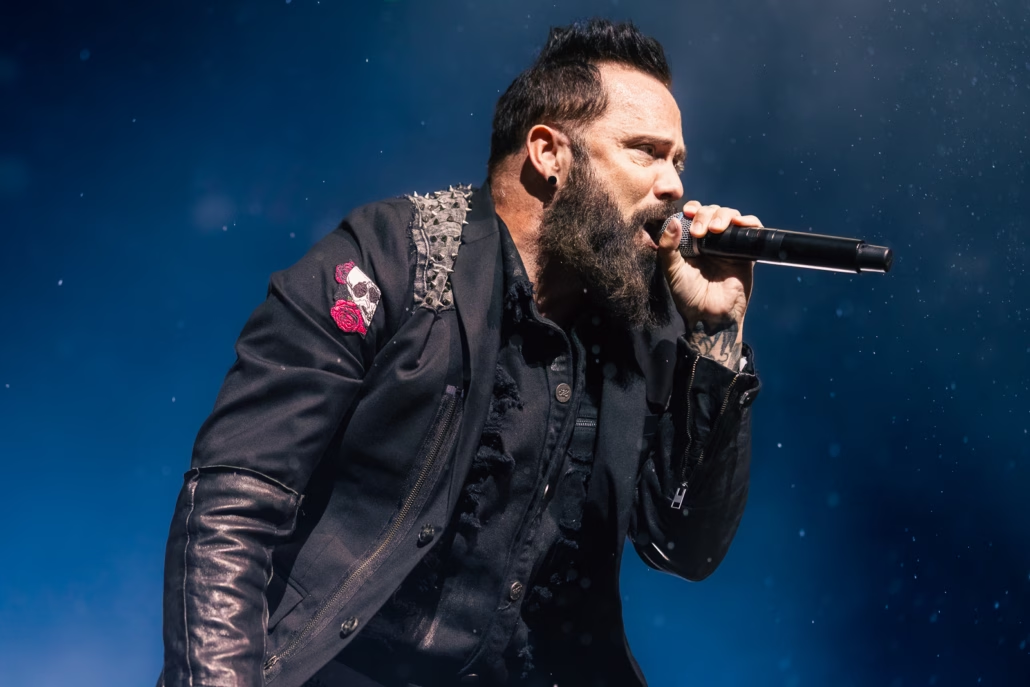
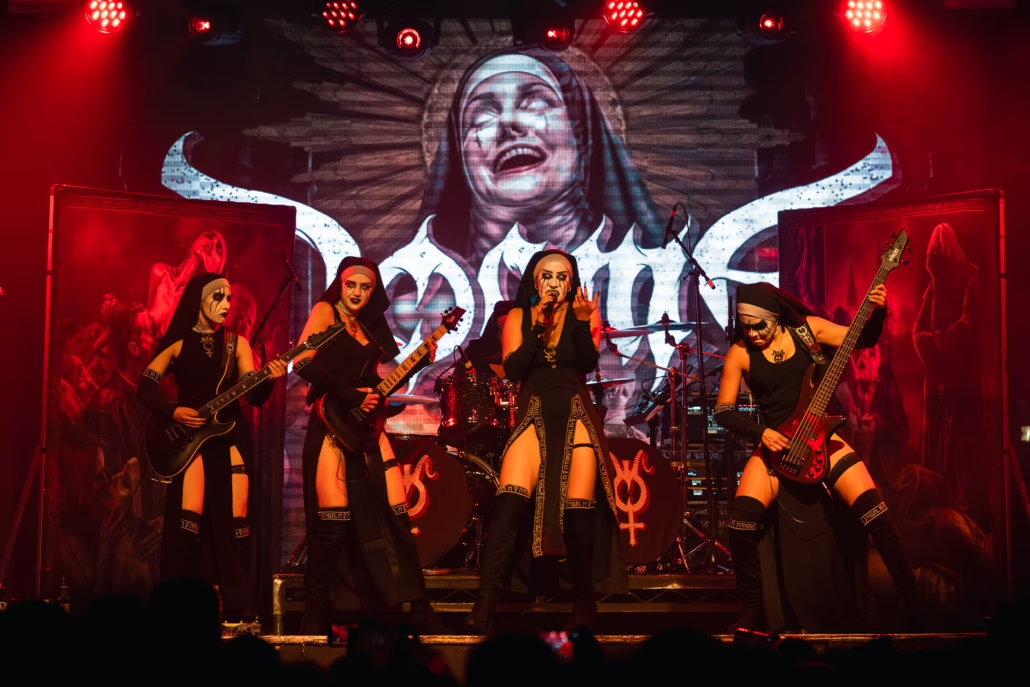
At a concert this is more useful than it sounds. A singer at f/1.8 from the pit barrier can be crisp at the eyes while the guitarist two metres behind softens into the lights. Shoot the same frame at f/8 and both musicians, the amp stack and the banner behind them all compete for attention. For one-person portraits, thin depth of field is separation. For a wide shot of a four-piece on a shallow stage, it can be a trap, because the bassist at f/1.4 may be soft when the singer is sharp.
Bokeh
Bokeh is the quality of the out-of-focus areas. Stage lights, being small bright points, turn into discs when they fall out of focus, and the aperture shape governs what those discs look like. Wide open they are round and soft. Stopped down they take on the polygon shape of the aperture blades. This is mostly a matter of taste, but if you like the creamy circular look, wide apertures and longer lenses deliver it.
Why wide open is the default
Todd Owyoung, writing on ishootshows, suggests shooting wide open as a baseline. With an f/2.8 zoom he only closes down once he is already at about 1/1000 second and under ISO 1600, and with f/1.4 or f/1.8 primes he stays at maximum. I agree with the logic. In a dark venue you are nearly always short of light, so the lens should be giving you everything it has.
This is why lens choice matters more than body choice for most beginners. A kit zoom at f/3.5 to f/5.6 gives up two or more stops compared with an f/2.8 zoom at the long end, and that is the cost of two full steps on the ISO dial. If you are weighing options, my notes on the best Sony lenses for concert photography and the broader guide to understanding camera lenses cover the practical choices.
When stopping down is the right call
Wide open is a default, and I stop down in a few situations.
- Lenses that are soft at maximum. Many lenses are clearly sharper one stop in. Imatest notes that most lenses have an optimum aperture around two stops below their maximum, because aberrations dominate wide open and diffraction takes over when you close down too far. On a very fast prime, a third or half a stop of closure can be worth the light.
- Several musicians at different distances. Stopping from f/1.8 to f/2.8 or f/4 widens the sharp zone enough that a drummer, guitarist and singer in a line all hold together.
- Big, bright stages. At a headline show with strong lighting, I may have more light than I can use at the shutter speed I want. A smaller aperture is then free, and the lens usually looks better for it.
- Close, fast subjects. At a very short distance, depth of field is paper thin. A touch more aperture gives autofocus a bit of margin when the subject moves.
Diffraction: the other end of the scale
Close the aperture too far and sharpness falls again. This is diffraction, light bending around the edges of the opening, and it is a physical limit that every lens has. How soon you see it depends on the size of the pixels. Photofocus notes that many guides regard f/11 as fine on lower-resolution full-frame cameras, while on 45 to 60 megapixel bodies softening can show from around f/8. You will rarely hit this at a gig, but it is a good reason not to treat “smaller aperture” as the safe option on a bright festival afternoon.
Letting the camera help: Aperture Priority
Sony describes Aperture Priority as the mode in which you pick the aperture and the camera adjusts the shutter speed. Paired with Auto ISO and a sensible minimum shutter speed, Fstoppers suggests this combination covers most of what many photographers shoot. For a first concert it is a gentler start than full Manual: set the lens wide open, set a minimum shutter speed, and let the camera juggle the rest. I go into this more in my guide to camera shooting modes.
A quick reference
| Situation | Aperture I’d start with | Why |
|---|---|---|
| Dark club, solo vocalist | Maximum, or one third stop in | Light first, separation second |
| Dark club, full band in a line | f/2.8 on a zoom, f/2 on a fast prime | Keeps more than one person sharp |
| Mid-size venue, decent light | f/2.8 to f/4 | Sharper corners, more margin |
| Bright outdoor stage | f/4 to f/5.6 | You have light to spare |
| Wide shot with lots of stage | f/4 or smaller if light allows | Stage depth needs sharpness |
These are starting points. I adjust every time the lighting changes.
Try this at the next concert
Pick one song and shoot the same frontperson at three apertures: wide open, one stop in, and two stops in. Keep the shutter speed above whatever freezes them and let Auto ISO absorb the rest. Afterwards, compare the three at 100 percent. You will learn how much sharpness your own lens gains from stopping down, and whether the extra ISO was worth it. For the bigger picture on how this fits with the other settings, see my concert photography camera settings guide and the general approach in low light photography. If three songs is all you get, read the older post on the three-song rule and plan your test around it. Everything ties together in the complete concert photography guide.
FAQ
What does f/2.8 mean?
It means the opening of the lens is the focal length divided by 2.8. On a 70mm lens, that is a 25mm opening. In practice it tells you that the lens is “fast” enough for most dim venues, and that each full stop below it (f/4, f/5.6) will halve the light again.
Is a lower f-number always better for concerts?
For light gathering, yes. For sharpness, not always. A lens wide open can be softer than it is one stop down, and a very thin slice of focus can miss the eyes when the subject moves. Most gig shooters use the widest aperture that still gives reliably sharp results.
What aperture should I use for concert photography?
Start wide open, or one third to one stop in if the lens is soft at maximum. Move to f/2.8 or f/4 when you have several people to keep sharp or the lights are bright. Change it when the lighting changes rather than leaving it fixed.
Does a wider aperture mean better low-light photos?
It gives you more light, which lets you use a faster shutter speed or a lower ISO. The photo is only better if you use that extra light well. A wide aperture with a slow shutter still gives a blurry frame.
Does aperture affect noise?
Not directly. The ISO setting adds amplification. But a wider aperture lets you lower the ISO for the same brightness, and that is how it ends up reducing visible noise.


